
Ireland's Closed-Cell Spray Foam Installers
Closed-Cell Spray Foam Insulation in Ireland
Rated 4.9/5
Verified customer reviews on Google over 10 years
NSAI & SEAI certified installations nationwide
Get a Quick Quote
Tell us about your project and we’ll respond with a fast, no-obligation estimate.
Commercial & Agriculture Spray Foam Experts
Rigid, Moisture-Resistant Insulation for Steel and Metal-Clad Buildings
Closed-cell spray foam is a rigid insulation we use on farm sheds, commercial units, shipping containers and other metal-clad buildings. It goes on as a liquid, expands and sets hard, bonding straight onto the steel and sealing around purlins, hook bolts and lap joints.
Because the cells are sealed, the foam takes in very little water and moisture vapour moves through it slowly. On a metal roof, that means the warm, damp air inside the building no longer meets cold steel, which is what causes condensation to form and drip.

Why choose Closed Cell Foam Insulation
Built for Sheds, Steel and Hard-Working Buildings
Stop the Drip
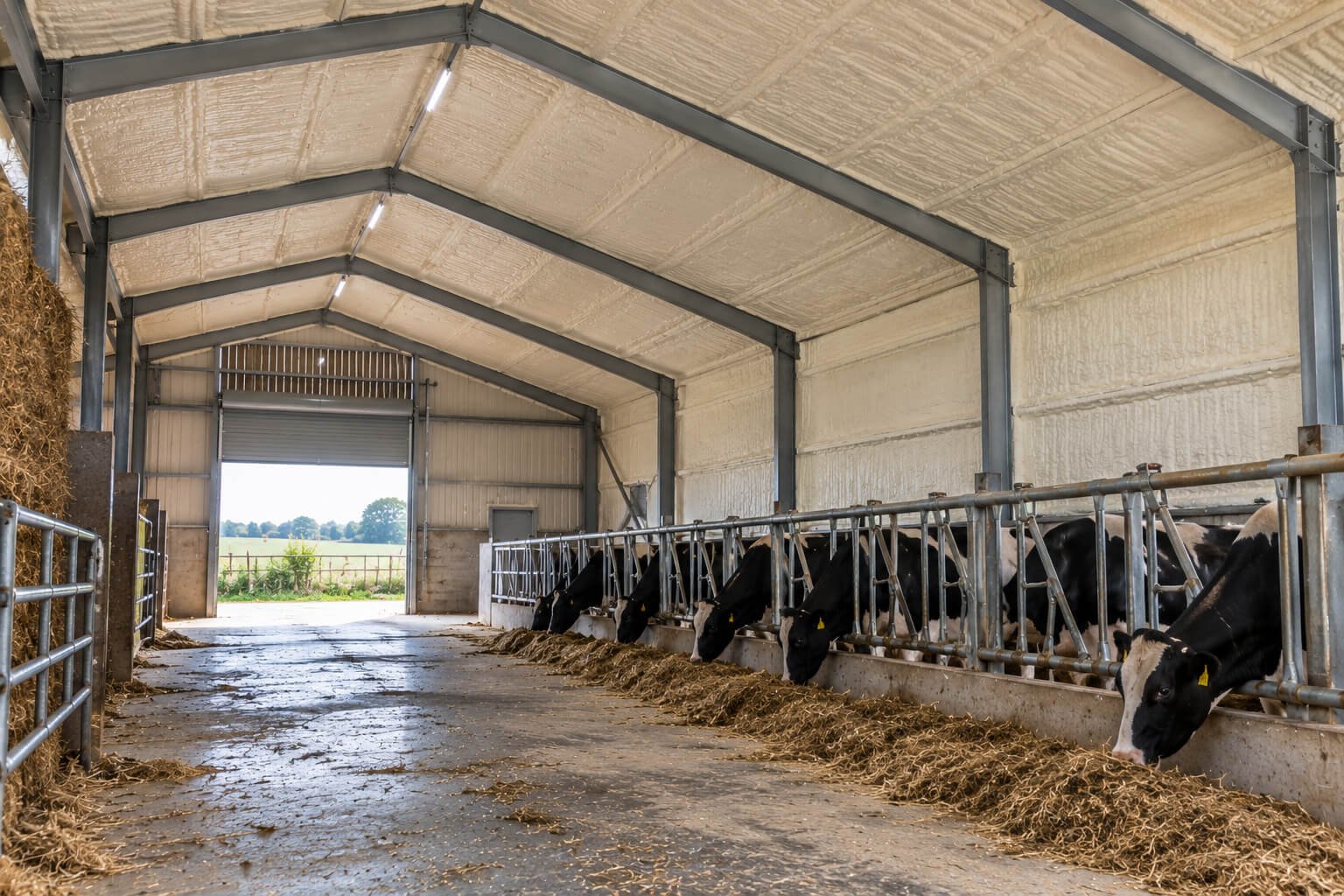
Condensation on the underside of a steel roof drips onto livestock, machinery, grain, straw and tools. Closed-cell foam covers the steel in one continuous layer, so the warm air inside the shed doesn't reach a cold surface.
More Insulation From Less Depth
Closed-cell foam has a thermal conductivity of 0.0215 W/mK, against 0.038 W/mK for a typical good open-cell foam. A thinner layer does the same job, which helps where there isn't much room to work with.
Stiffer Sheeting
Once it sets, the foam is hard and bonded to the sheeting, which adds a level of rigidity to the roof and walls.
Stands Up to Damp
With sealed cells and low water absorption, closed-cell foam copes well in damp farm and industrial conditions. It gives mould nothing to feed on.
Applications
Where Closed-Cell Spray Foam Is Used
Closed-cell foam is made for buildings where damp, condensation and cold steel are the problem.
- Farm sheds, barns and calving units
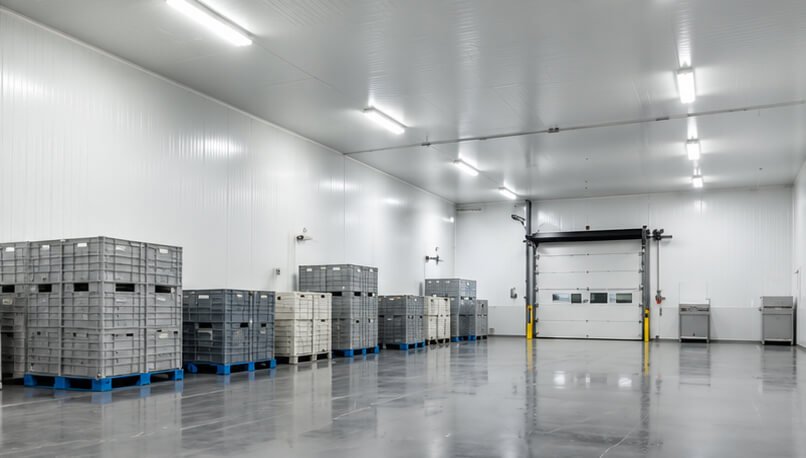
- Steel-clad commercial units, warehouses, workshops and garages
- Shipping containers and modular units
- Boats and marine work
Not sure which foam you need? We'll look at the building during the survey and tell you whether closed-cell or open-cell spray foam is the right fit.


Plain-English guide
Understanding Closed-Cell Spray Foam
Spray foam data sheets and quotes are full of technical terms. Here's what each one actually means, and exactly what you're getting with the foam we install.
What NSAI Agrément certification means
NSAI is the National Standards Authority of Ireland. An NSAI Agrément certificate is independent confirmation that a building product is fit for its intended use under Irish site conditions and meets the Building Regulations, provided it's installed exactly as the certificate sets out.
The closed-cell foam we use, PUREX NG CC2000, is covered by NSAI Agrément Certificate No. 26/0450, issued in June 2026. The certificate also sets out how the foam must be installed, including vapour control and fire protection.
| The term | What it means for you | PUREX NG CC2000 | Source |
|---|---|---|---|
| Thermal conductivity λ, "lambda" | How easily heat passes through the material. The lower the number, the better it insulates. | 0.0215 W/mK | EN 12667 |
| U-value W/m²K | How much heat the whole roof or wall loses once it's insulated. Lower is better. It depends on the foam depth and how the building is put together, so it's worked out for each job. | Calculated for your building | I.S. EN ISO 6946 |
| Density kg/m³ | How much foam is packed into each cubic metre. Closed-cell foam is much denser than open-cell, which is what makes it rigid. Installers check it on site before spraying. | Minimum 32 kg/m³ core density | EN 1602 |
| Closed-cell content | The share of cells that are sealed. The more sealed cells, the less water and vapour get in. | 90% or more | EN ISO 4590 |
| Compressive strength kPa | How much load the foam takes before it squashes. It's part of what makes closed-cell foam hard-wearing. | 150 kPa or more, at 10% deformation | EN 826 |
| Vapour resistance μ, "mu" | How easily moisture vapour passes through. A higher number means vapour moves through more slowly. | μ = 50–60 | EN 12086 |
| Water absorption kg/m² | How much water the foam soaks up. Low is better for damp sheds and steel buildings. | 0.14 kg/m² or less (short-term) | EN 1609 |
| Reaction to fire Euroclass | How the material behaves in a fire. Like other foam insulation, it's combustible on its own, so what it needs to be covered with depends on how the building is used. We'll advise on this for your job. | Combustible on its own; covered where the use of the building requires it | TGD Part B |
| Mould | Whether mould can grow on the insulation. | No food source for mould | NSAI 26/0450 |
| Indoor air quality VOCs | Whether it gives off harmful chemicals once installed. | Assessed for VOC emissions, within indoor limits | ITB assessment |
| Blowing agent | What makes the foam expand. | HFO, zero ozone depletion, low global warming potential | TDS |
| Operating temperature | The temperature range the cured foam is designed to work in. | -30°C to +80°C | TDS |
| CE marking | Made and tested to the European standard for spray foam insulation. | CE marked | EN 14315-1:2013 |
Figures from NSAI Agrément Certificate 26/0450 and the manufacturer's technical data sheet. Performance depends on correct installation and the building's construction.
What you get with every Spray Foam Direct installation
- PUREX NG CC2000, certified under NSAI Agrément 26/0450
- Installers approved and trained by Polychem, the manufacturer
- A survey of your building before any work starts
- Foam density checked and recorded on site
- A sign-off sheet when the job is finished
Quick comparison
Closed-Cell vs Open-Cell
| Feature | Closed-cell foam | Open-cell foam |
|---|---|---|
| Best for | Farm sheds, containers, metal roofs | Domestic attics, rafters, timber frame |
| Structure | Hard, rigid, sealed cells | Soft, flexible, open cells |
| Thermal conductivity | 0.0215 W/mK | 0.038 W/mK |
| Breathability | Low vapour permeability (μ 50–60) | Vapour open (μ 3–4) |
| Movement | Adds a level of rigidity to steel sheeting | Flexible material that can accommodate some movement |
| Sound absorption | Low | High |
Swipe to see the full table →
Closed-cell questions
Frequently Asked Questions
Will closed-cell foam stop condensation in my shed?
Yes, when the underside of the roof is fully covered. The foam keeps the warm, damp air inside the shed away from the cold steel, so condensation can't form on it. Livestock housing still needs proper ventilation for the animals.
Does it make the roof stronger?
It adds a level of rigidity to the sheeting once it sets, but it isn't a repair for a damaged or failing roof. We'll check the condition of the roof during the survey.
Will closed-cell foam stick to a rusty roof?
It will if the metal is sound. Loose or flaking rust and heavy grease have to be wire-brushed or cleaned off first, so the foam bonds to solid steel. We'll check this during the survey.
Can you insulate a shipping container?
Yes. Closed-cell foam is what we use for containers and modular units, because it bonds to the steel and handles condensation well.
When can animals and people go back in?
The area needs to be ventilated and left empty for a period after spraying. Our installers will tell you when it's safe. In pens where animals might chew or rub the walls, we recommend timber kickboards or sheeting over the lower section.
Should I use closed-cell foam in my house?
Usually not. For domestic attics and timber frame, open-cell foam is the better fit. See our open-cell spray foam page for more.