
Ireland's Spray Foam Insulation Experts
Open-Cell Spray Foam Insulation in Ireland
Rated 4.9/5
Verified customer reviews on Google over 10 years
NSAI & SEAI certified installations nationwide
Get a Quick Quote
Tell us about your project and we’ll respond with a fast, no-obligation estimate.
The Home Spray Foam Insulation Experts
Breathable, Airtight Thermal Insulation for Irish Homes
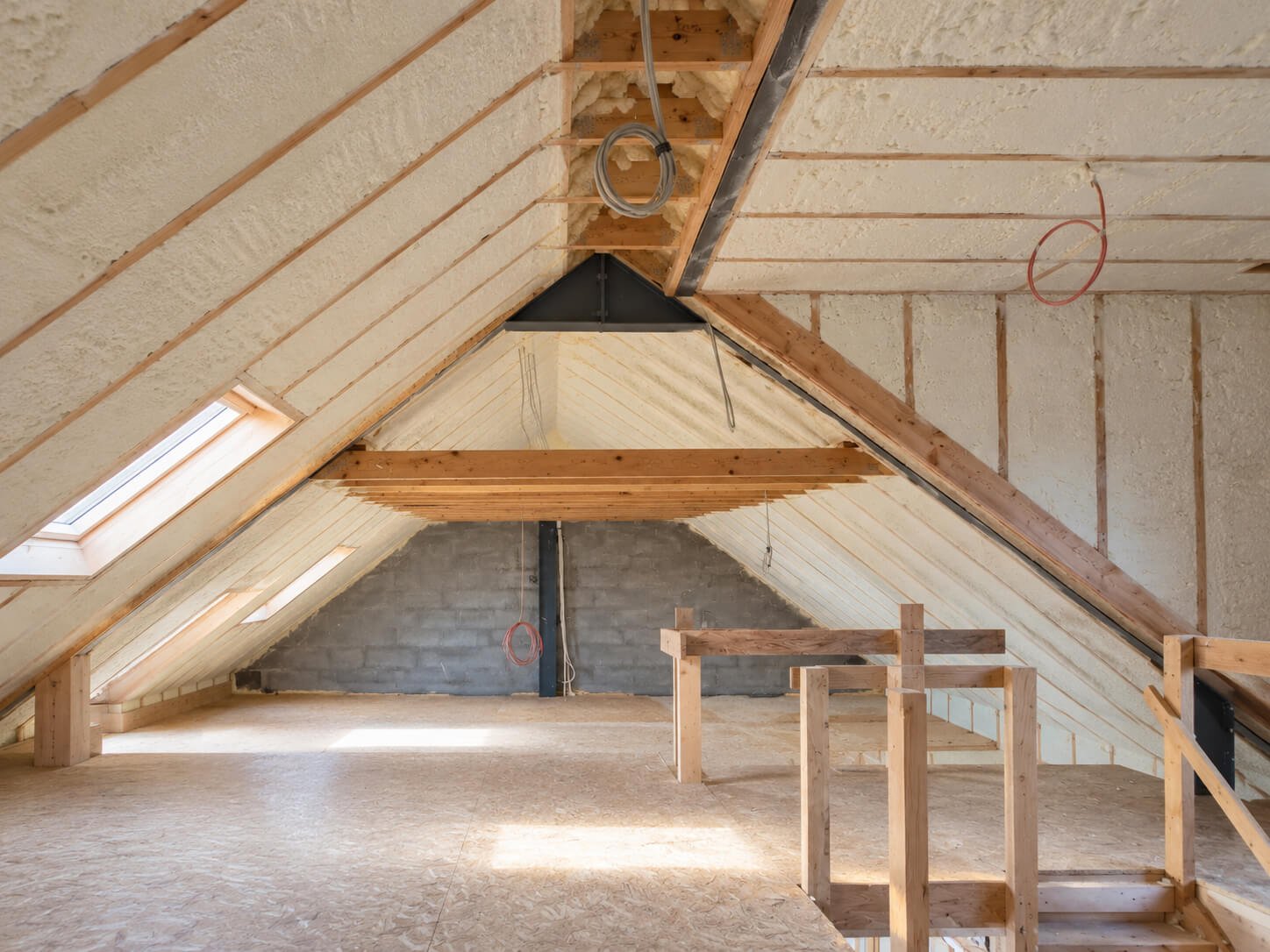
Open-cell spray foam is an advanced, expansion-moulded insulation designed specifically for residential properties, timber frame structures, and domestic roof spaces. Applied as a liquid, it expands up to 100 times its original volume within seconds, filling every micro-gap, crack, and hard-to-reach void across timber rafters and wall studs.
Unlike traditional insulation rolls or rigid boards, open-cell spray foam expands to form a continuous insulating layer that helps reduce unwanted air leakage. Its vapour-permeable structure allows moisture vapour to diffuse through the material, while appropriate ventilation and vapour control measures help manage condensation risks and protect the roof structure.

SEAI Home Grants
Grants of up to €2,500 for eligible attic insulation upgrades.
Why choose Open Cell Foam Insulation
Benefiting You and Your Home
Lower Bills & a Better BER
A poorly insulated attic can account for up to 30% of a home's heat loss. Open-cell foam seals the roof and stops cold air getting in, so your heating works less. It can help older houses jump more than one BER band, which can open the door to green mortgage rates.
No More Draughts or Cold Spots
Roll insulation can leave gaps around joists, wiring and pipework. Open-cell foam expands into those gaps, cutting out draughts and keeping temperatures even from room to room.
A Quieter Home
The soft, open-cell structure absorbs sound. It reduces noise from heavy rain on the roof, traffic and wind for a calmer house.
Done in a Day
Many straightforward domestic attic installations can be completed within a single working day, although larger or more complex roofs may require additional time.
Applications
Where Open-Cell Spray Foam Is Used
Open-cell foam is made for internal timber structures where breathability, thermal performance and sound absorption all matter.
- Attic rafters and pitched roof slopes
- Timber frame wall cavities and internal stud walls
- Dormer knee walls and sloped ceilings
- Suspended timber ground floors and mid-floor cavities
Where it shouldn't go: open-cell foam isn't suitable for metal-clad sheds, steel shipping containers or other non-breathable agricultural and commercial buildings. For those, we use our closed-cell spray foam system.
Plain-English guide
Understanding Open-Cell Spray Foam
Spray foam data sheets and quotes are full of technical terms. Here's what each one actually means, and exactly what you're getting with the foam we install.
What NSAI Agrément certification means
NSAI is the National Standards Authority of Ireland. An NSAI Agrément certificate is independent confirmation that a building product is fit for its intended use under Irish site conditions and meets the Building Regulations, provided it's installed exactly as the certificate sets out.
The open-cell foam we use, PUREX NG OC500, holds NSAI Agrément Certificate No. 26/0450, issued in June 2026. The certificate also sets out how the foam must be installed, including ventilation, vapour control and fire protection.
| The term | What it means for you | PUREX NG OC500 | Source |
|---|---|---|---|
| Thermal conductivity λ, "lambda" | How easily heat passes through the material. The lower the number, the better it insulates. | 0.038 W/mK | EN 12667 |
| U-value W/m²K | How much heat your whole roof loses once it's insulated. Lower is better. It depends on the foam depth and how your roof is built, so it's worked out for your house. | Calculated for your roof and recorded, before and after, on your job sign-off sheet | I.S. EN ISO 6946 |
| Density kg/m³ | How much foam is packed into each cubic metre. "Free-rise" is the density when the foam expands freely in a test; "installed" is what ends up in your roof. Open-cell foam is meant to be light, but it must fall within the certified range. Installers have to check it on site before spraying, because foam that's too spongy or too brittle points to a bad mix or poor installation. | 7–9 kg/m³ free-rise 8–15 kg/m³ installed | NSAI 26/0450 |
| Vapour resistance μ, "mu" | How easily moisture vapour passes through. A low number means the foam breathes, so moisture can escape instead of being trapped against your roof timbers. | μ = 3–4 | EN 12086 |
| Reaction to fire Euroclass | How the material behaves in a fire. Like most foam insulation, it's combustible on its own, so it must be covered with plasterboard (such as 12.5mm) anywhere the space is lived in. An unoccupied loft that's sealed off from the house is the only exception. | Class F (foam on its own) | EN 13501-1:2018 |
| Sound absorption αw | A laboratory-measured indication of how effectively the material absorbs sound across a range of frequencies. A higher rating generally indicates better sound absorption. The performance of a complete roof or wall construction also depends on the other materials and how they are assembled. | αw = 0.50 (Class D) | EN ISO 11654 |
| Mould & pests | Whether anything can live off the insulation. Testing found the foam gives mould nothing to feed on, and it's no food source for rodents or insects. | No food source for mould, rodents or insects | NSAI 26/0450 |
| Indoor air quality VOCs | Whether it gives off harmful chemicals once installed. It's water-blown, with no CFCs, HCFCs, HFCs or formaldehyde used, and emissions testing found nothing above safe limits for living spaces. | No exceedances found | EN 16516 |
| Durability | How long it keeps insulating as well as it did on day one. | Thermal performance stable over 25 years | Declaration of Performance |
| CE marking | Made and tested to the European standard for spray foam insulation. | CE marked | EN 14315-1:2013 |
Figures from NSAI Agrément Certificate 26/0450 and the manufacturer's Declaration of Performance. Performance depends on correct installation and the building's construction.
What you get with every Spray Foam Direct installation
- PUREX NG OC500, certified under NSAI Agrément 26/0450
- Installers approved and trained by Polychem, the manufacturer
- A survey of your roof before any work starts
- Foam density checked and recorded on site
- A 50mm ventilated gap with breathable rafter cards, where your roof needs it
- A sign-off sheet recording your roof's U-value before and after
For specifiers
Technical Summary for Architects & Engineers
U-Values & Depths
U-values depend on the full build-up, so they're calculated per job to I.S. EN ISO 6946. For reference, NSAI Agrément Certificate 26/0450 gives these for open-cell foam at rafter level in a new pitched roof (rafters battened out to depth, 50mm ventilated space, AVCL and 12.5mm plasterboard):
- 280mmU = 0.16 W/m²KNSAI 26/0450
- 325mmU = 0.14 W/m²KNSAI 26/0450
For retrofits, U-values for specific constructions come from the manufacturer's technical documentation. Our installers record the before and after U-values on the job sign-off sheet.
Condensation Control
Open-cell foam is vapour open (μ = 3–4), so it isn't a vapour barrier. The certificate requires a VCL on the warm side unless a BS 5250 assessment shows it isn't needed. Roof ventilation follows TGD Part F, with continuous ventilation at the eaves and apex.
Fire Performance
PUREX NG OC500 is Euroclass F on its own (EN 13501-1:2018). It must be contained by a suitable lining board, such as 12.5mm plasterboard with sealed joints. The only exception is an unoccupied loft separated from the habitable part of the dwelling. Separation from chimneys and heating appliances follows TGD Part J.
Quick comparison
Open-Cell vs Closed-Cell
| Feature | Open-cell foam | Closed-cell foam |
|---|---|---|
| Best for | Domestic attics, rafters, timber frame | Farm sheds, containers, metal roofs |
| Structure | Soft, flexible, open cells | Hard, rigid, sealed cells |
| Breathability | Vapour open (μ 3–4) | Low vapour permeability (μ 50–60) |
| Movement | Flexible material that can accommodate some movement. | Adds a level of rigidity to steel sheeting |
| Sound absorption | High | Low |
| 50mm ventilated gap on pitched timber roofs? | Yes, on existing roofs | Yes, on existing roofs |
Swipe to see the full table →
Your installation
What to Expect on installation Day
Survey & Protection
Our installers survey the roof, check attic access, cover water tanks, mask off hatches and electrical boxes, and lay down floor protection.
Rafter Card Fitting
Breathable rafter cards are fitted between the rafters, forming the 50mm ventilated gap against the roof felt.
Density Check & Spraying
The foam's density is checked and recorded, then it's sprayed in even layers across the rafter cards and rafter sides to the specified depth.
During Installation
During installation, the work area must remain unoccupied and adequately ventilated. Our installers will advise when the property can safely be reoccupied.
Paperwork Handed Over
You get a job sign-off sheet recording your roof's U-value before and after, plus your installation certificate and warranty.

Open-cell questions
Frequently Asked Questions
Will open-cell spray foam rot my roof timbers?
No. Installed with rafter cards, a 50mm ventilated gap stays open behind the foam, and the foam itself lets moisture vapour through. That stops damp building up against the timber.
Will I be able to sell my home or get a mortgage later?
Yes. Surveyors and lenders raise spray foam when it's uncertified, has no documentation, or was sprayed straight onto the felt without a ventilation gap. We install to the conditions of the foam's NSAI Agrément certificate and give you the paperwork to show it.
Can I still use my attic for storage?
Yes. When the rafters are sprayed, the attic floor joists stay clear, so you can board the floor (subject to structural capacity) and use the space for storage.
Does it smell? When can we move back in?
The foam gives off vapours while it's being sprayed and reacting. The house is aired out and must be left empty for at least 24 hours afterwards, as the NSAI certificate requires.
Can I get an SEAI grant for spray foam attic insulation?
Eligible homeowners can receive SEAI attic insulation grants of up to €2,000, with enhanced grants of up to €2,500 available to qualifying applicants. Grant eligibility depends on the property, applicant and installation meeting SEAI requirements. See our SEAI grants page for details.